Simona Pavoni: À Jour
“I tried to capture the light
in the reflections with which it decorates the air.
I am trying to be
all the things I feel.” ²
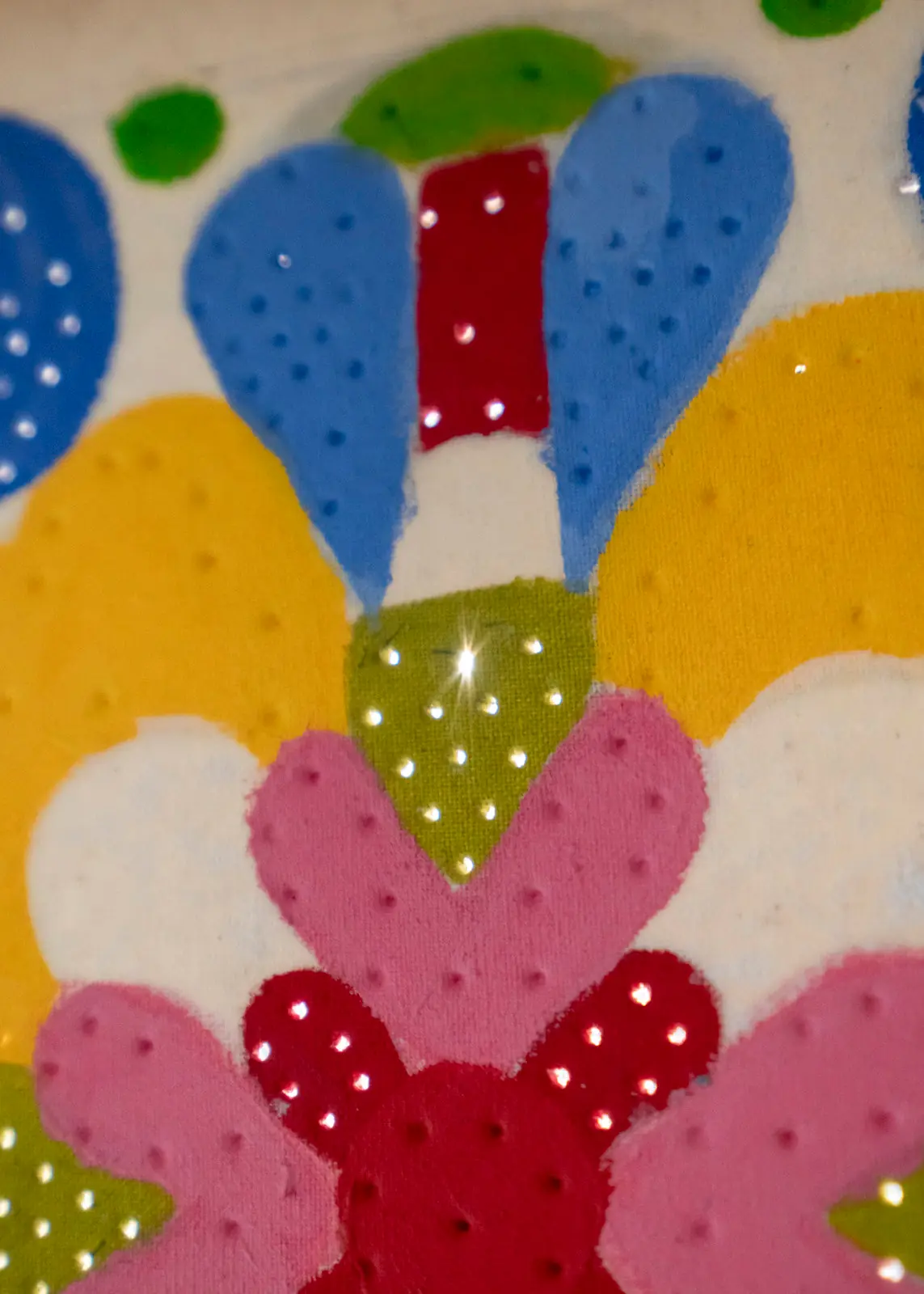
Simona Pavoni investigates corporeality in its vital dimension, that is, capable of generating reverberations, interactions, and exchanges between contiguous dimensions. By placing emphasis on the structural qualities of materials and on the possibility of entering into resonance with one another, the artist gives form to “total” environments in which works and space become a whole of sensitive textures and intermittent luminescences. The generative process of the works is meticulous and careful, it passes through thousands of holes and several hours of work, it is rhythmic and meditative: precisely like embroidery. The gesture of embroidery is close to Pavoni’s work on several levels. On the one hand, the artist pierces and bastes her works, generating patterns that render the surfaces permeable; on the other, she sews together works, space, and light within stratified devices. The hole, minimal module repeated in her works, is the symptom of a sensitivity oriented toward the micro, the detail as nucleus charged with a broader semantic potential.
À Jour, title of her first solo exhibition presented by Mare Karina gallery, is a French expression that refers to the openwork technique but also to the idea of an opening to the present time. It is a word that evokes the dual nature of the installation: on the one hand its link with the temporal dimension, on the other its weave permeable to light: a tension that takes shape within an organism that constantly renews itself through the gaze, the bodies, and the light that cross it.
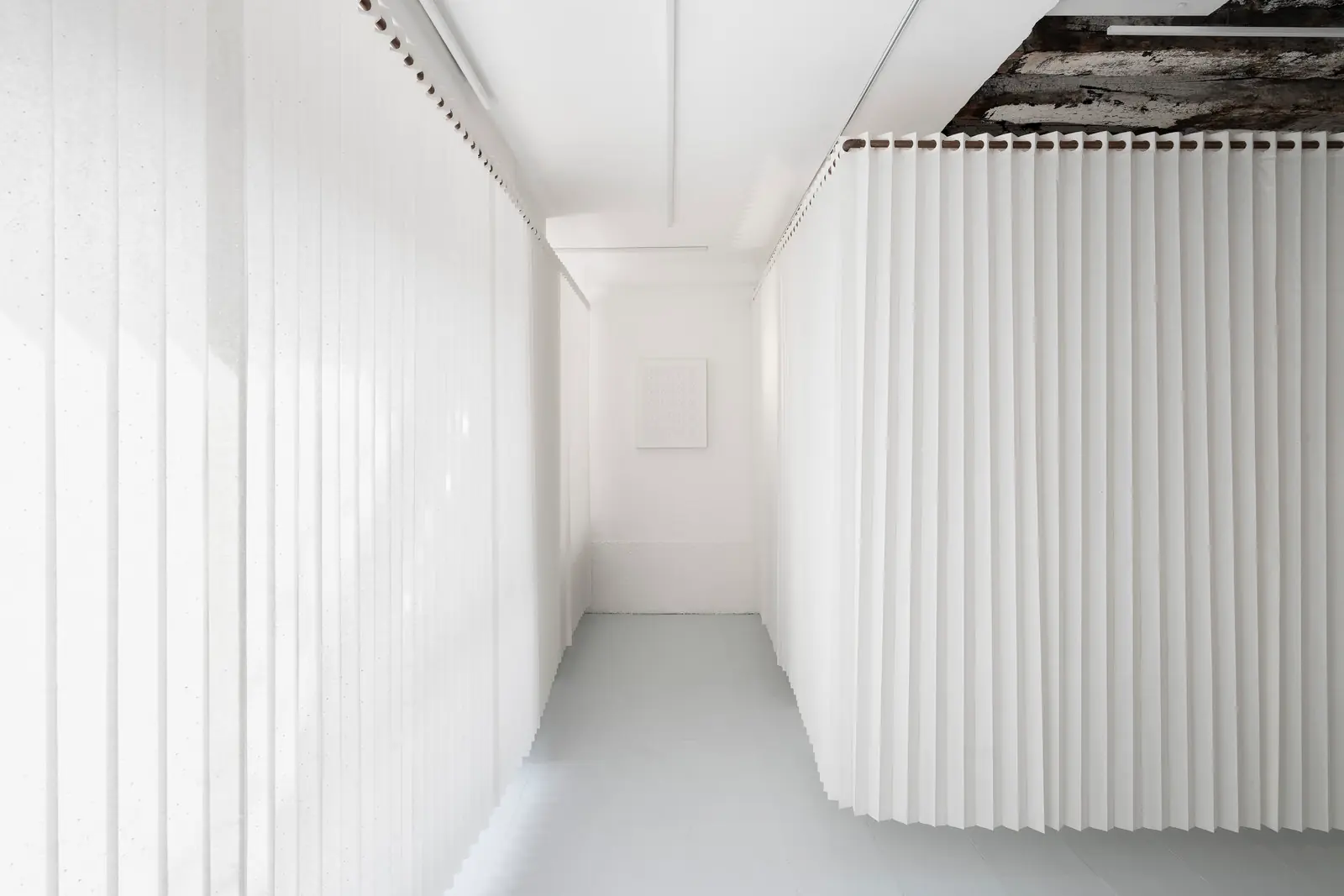
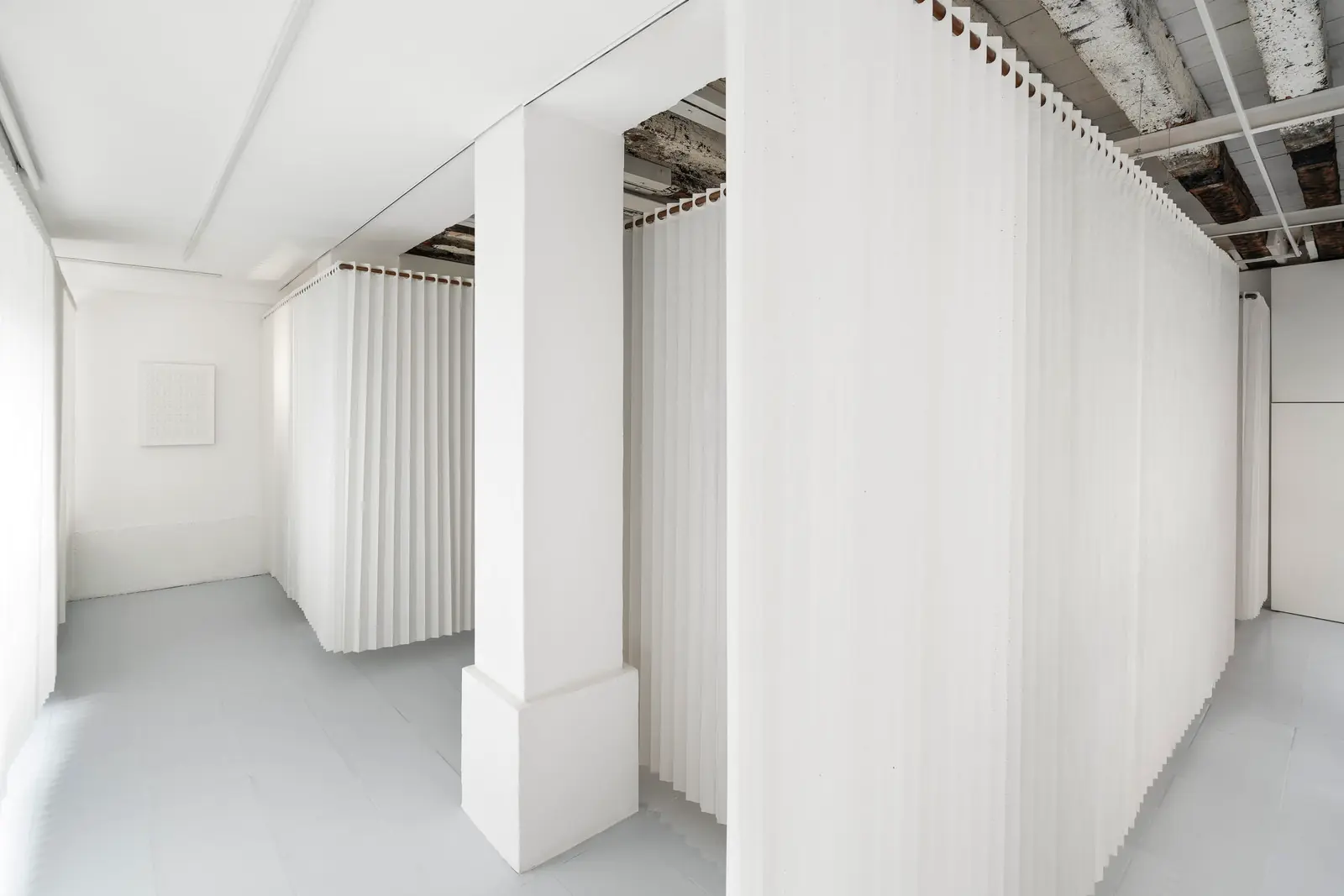
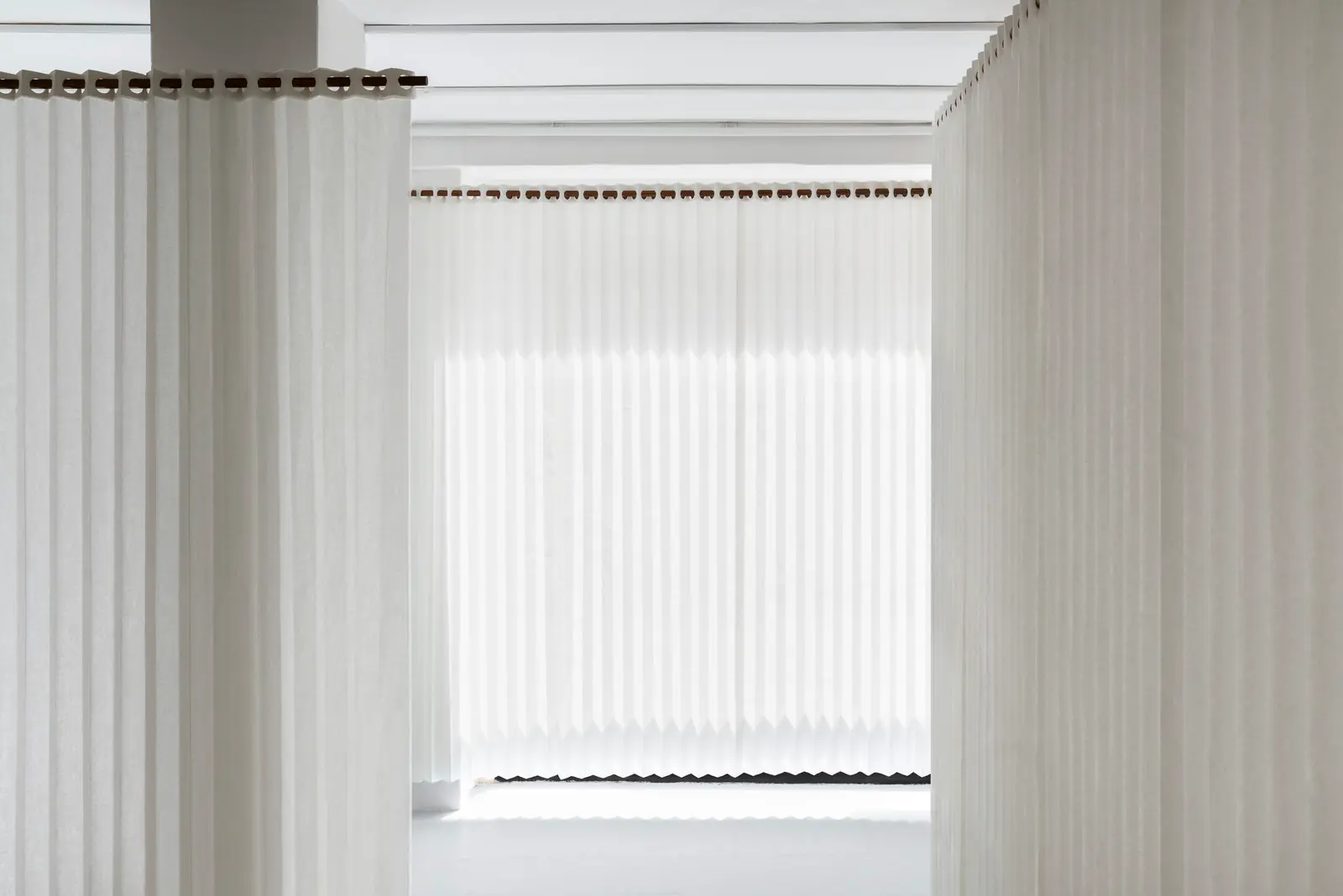
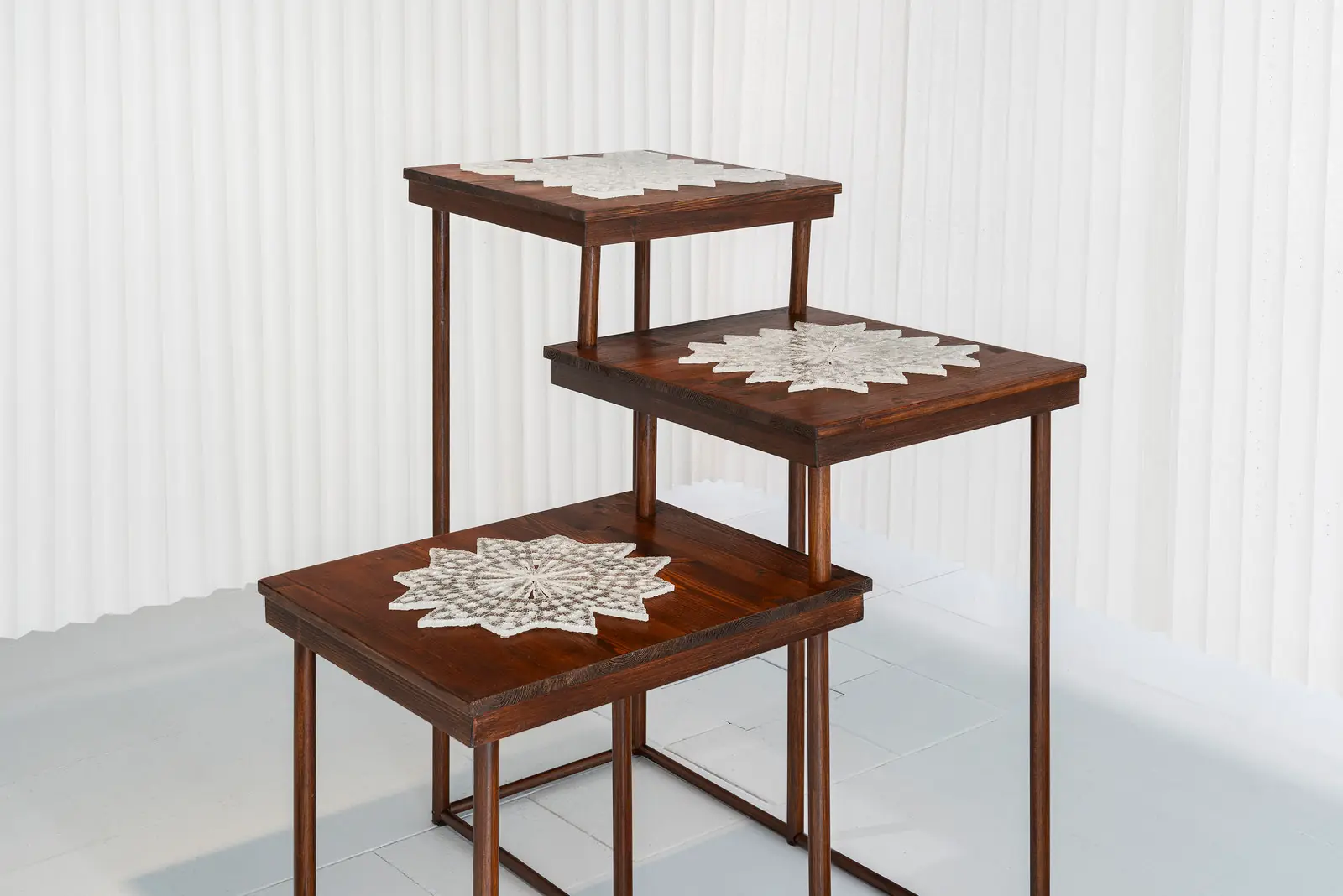
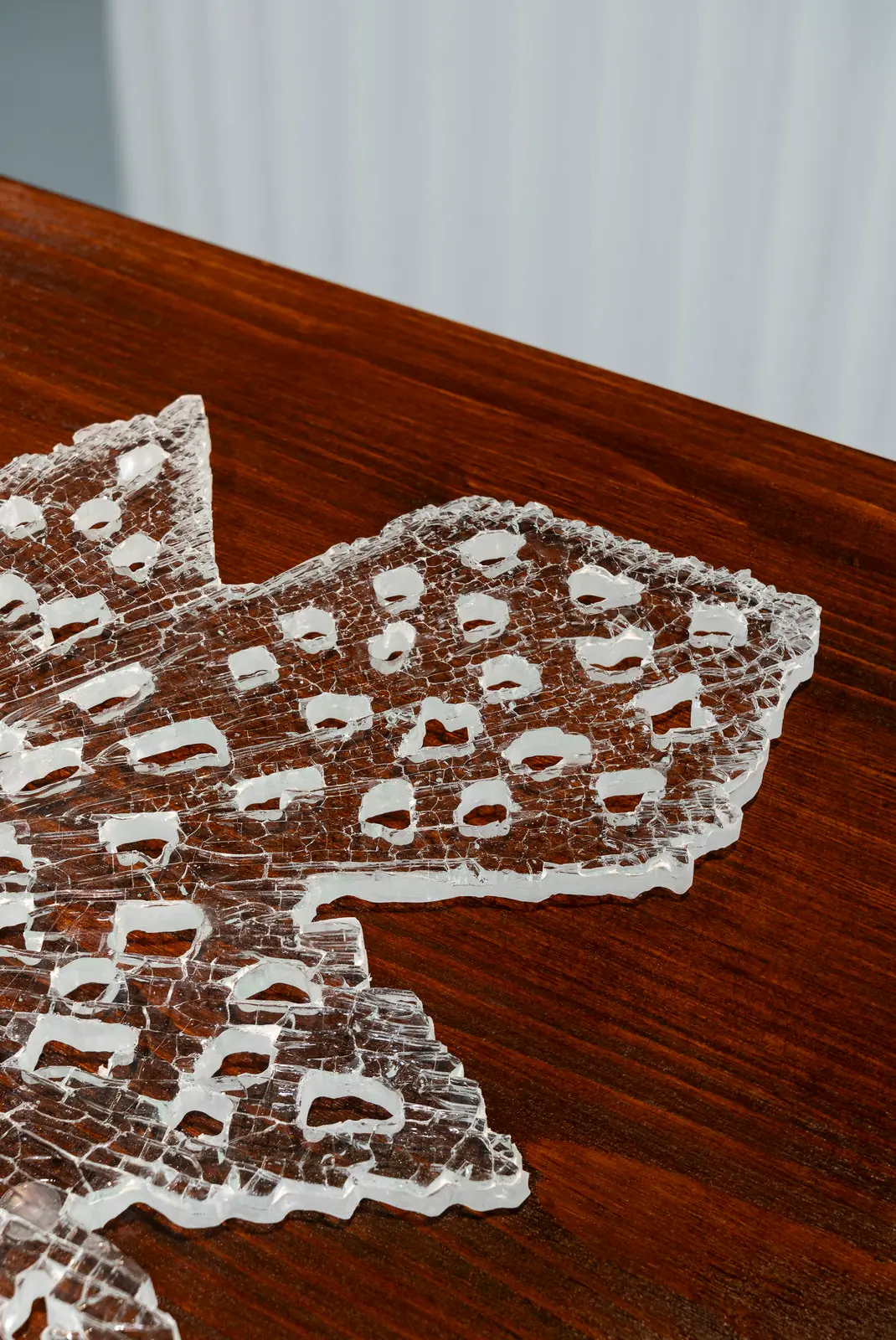
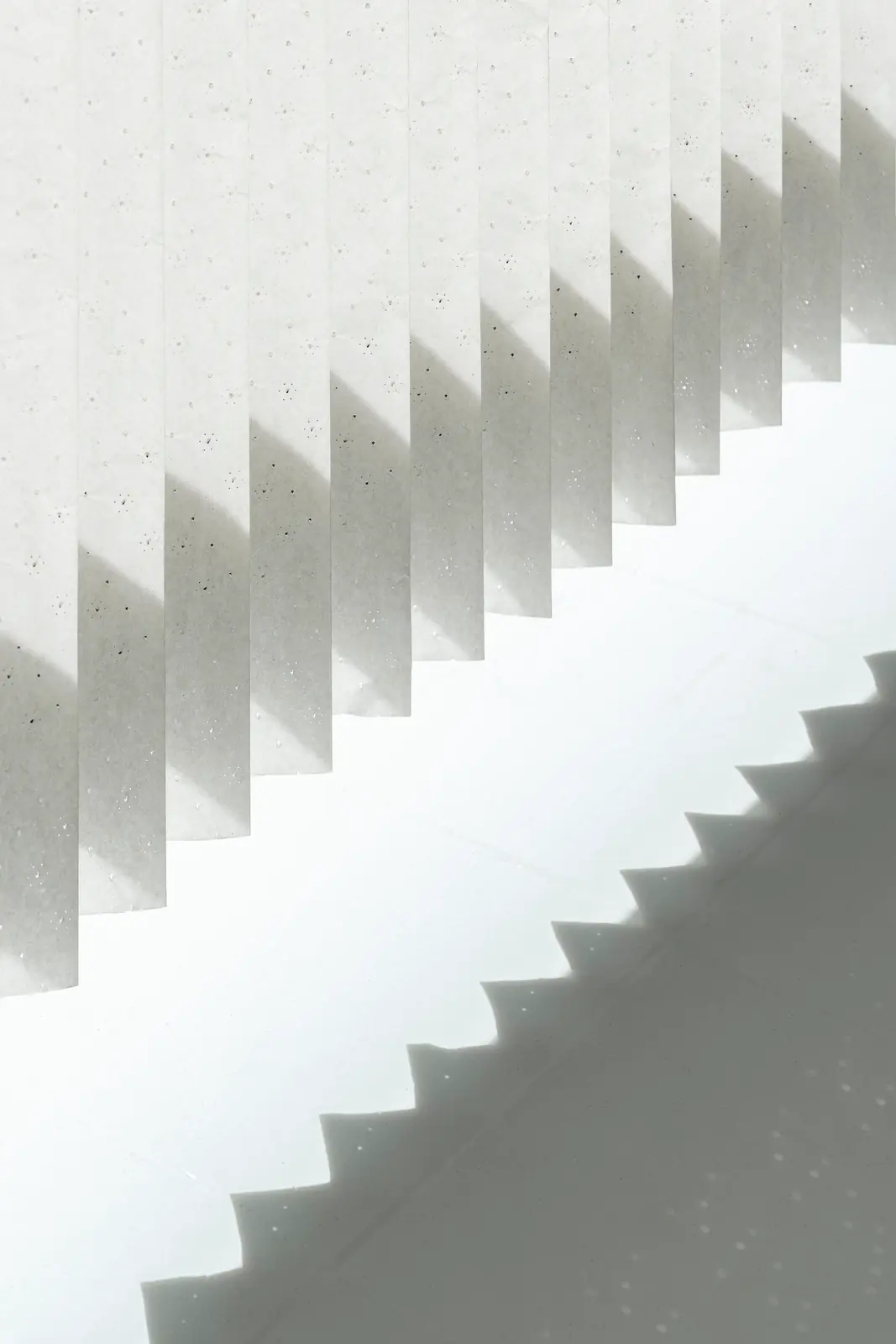
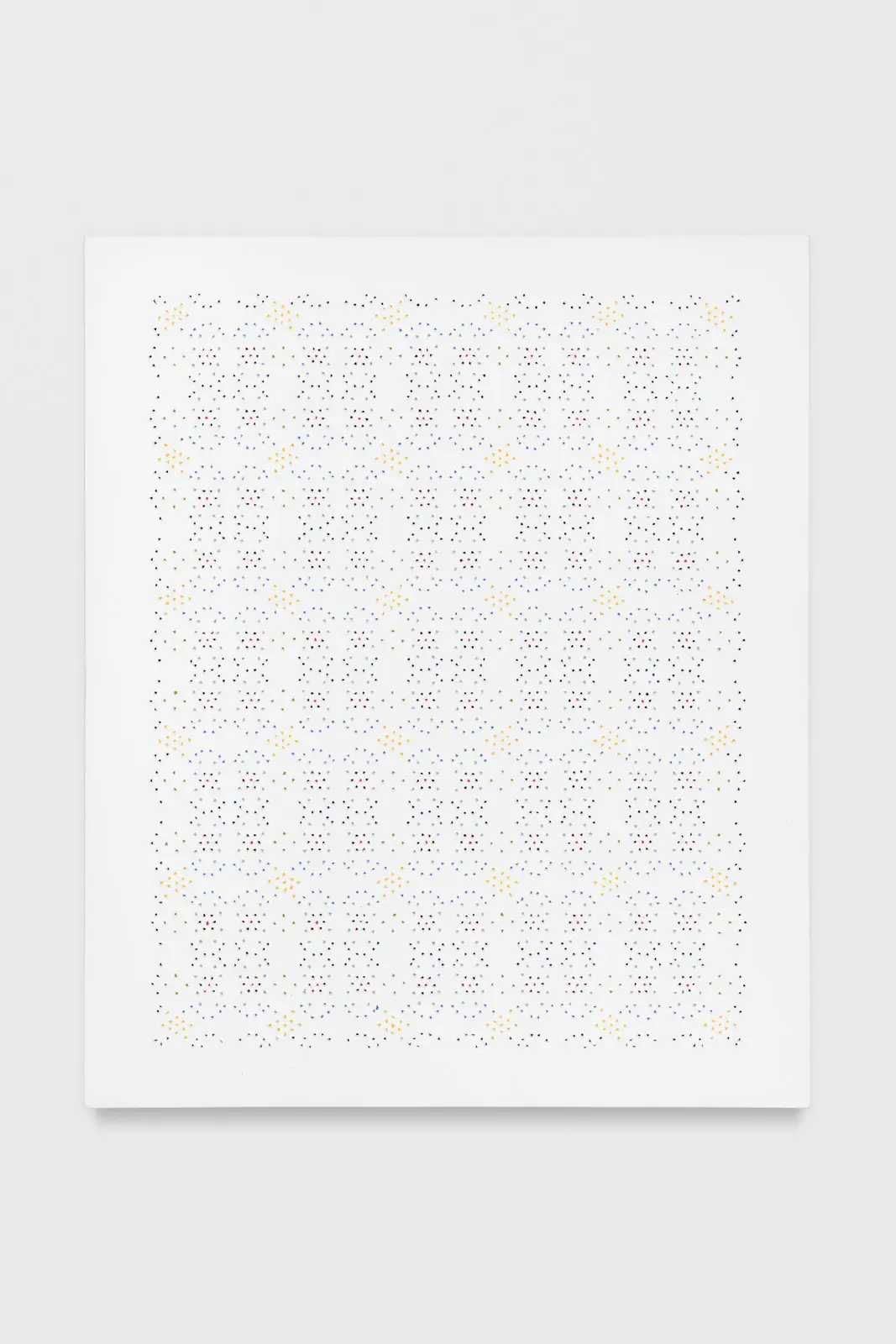
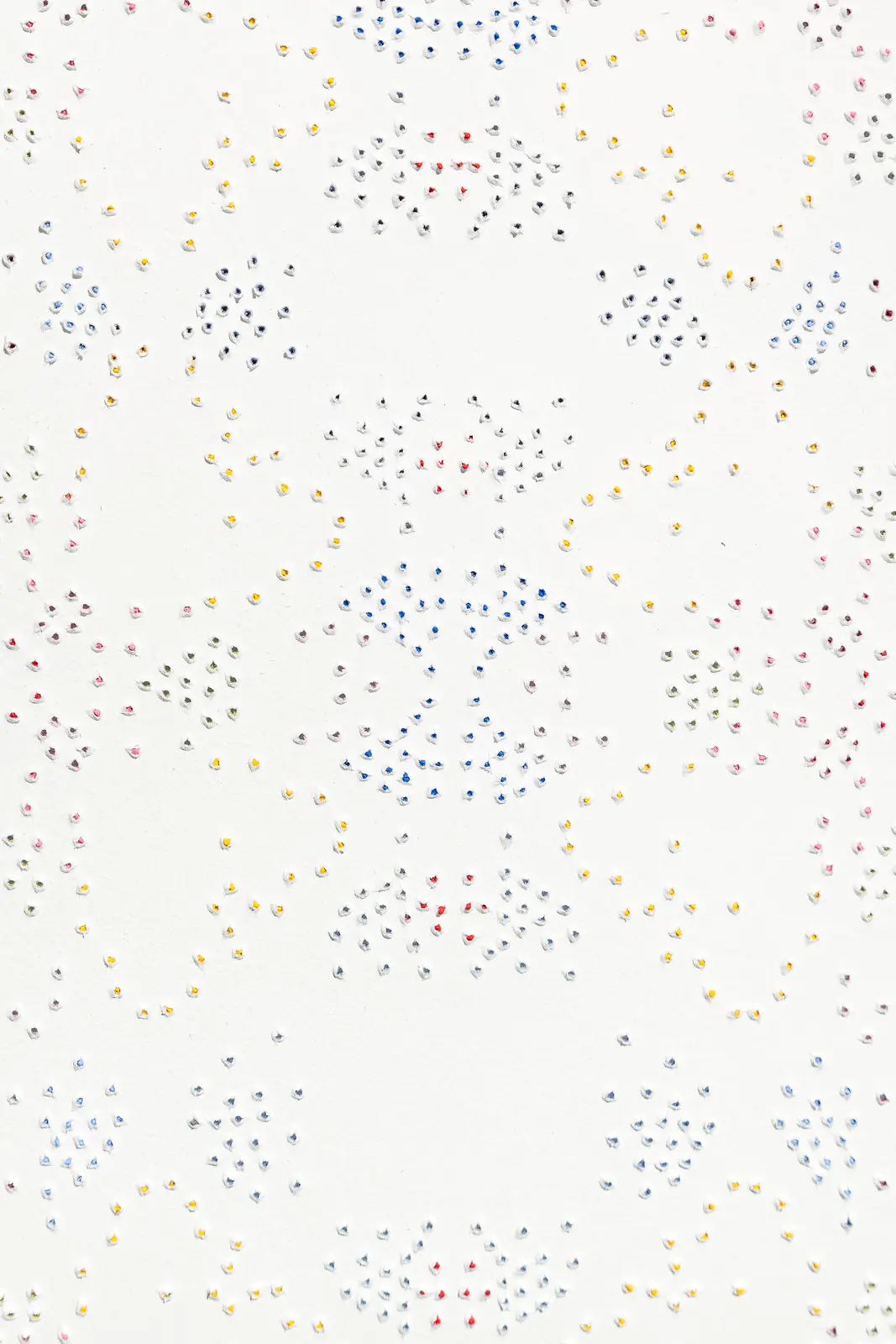
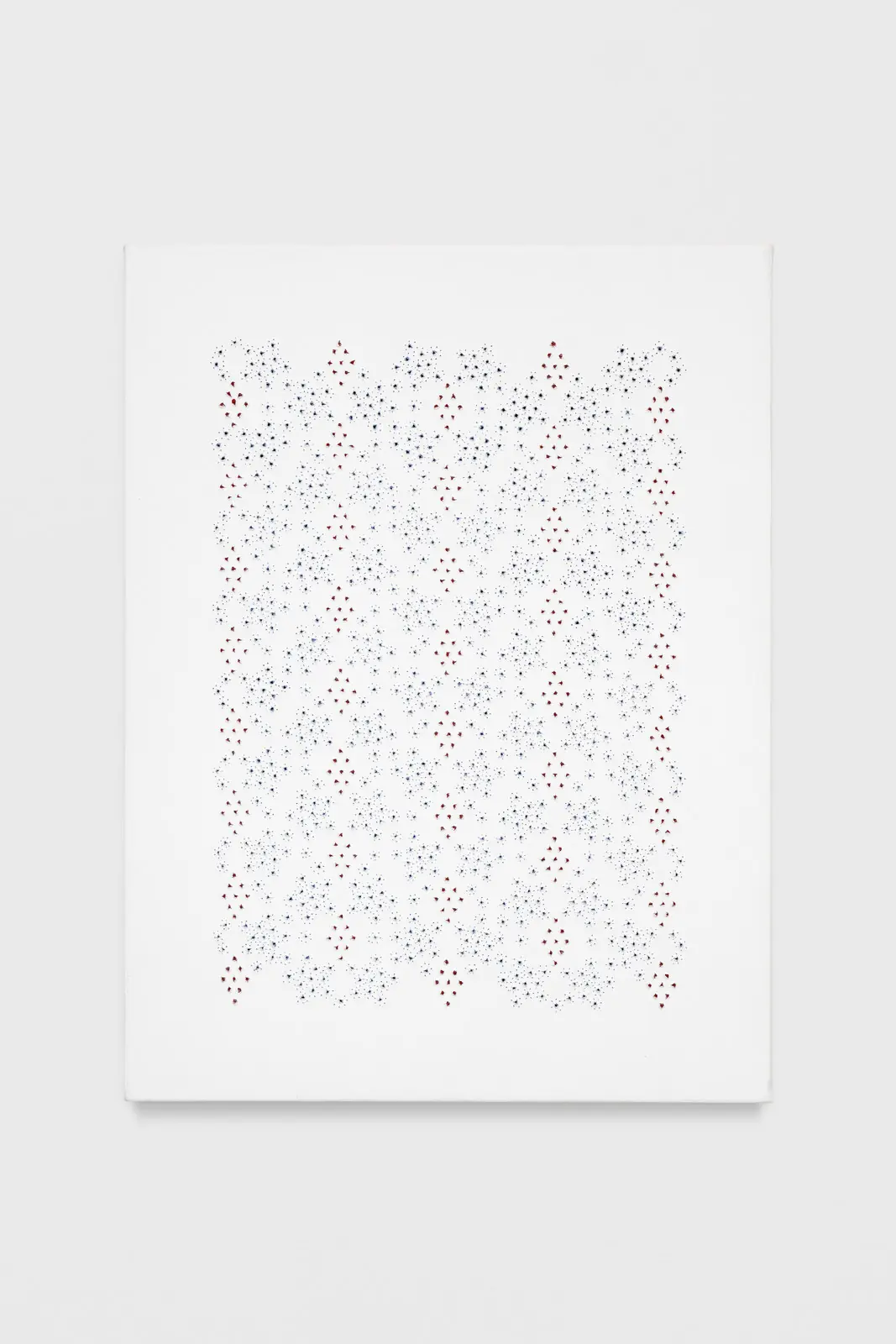
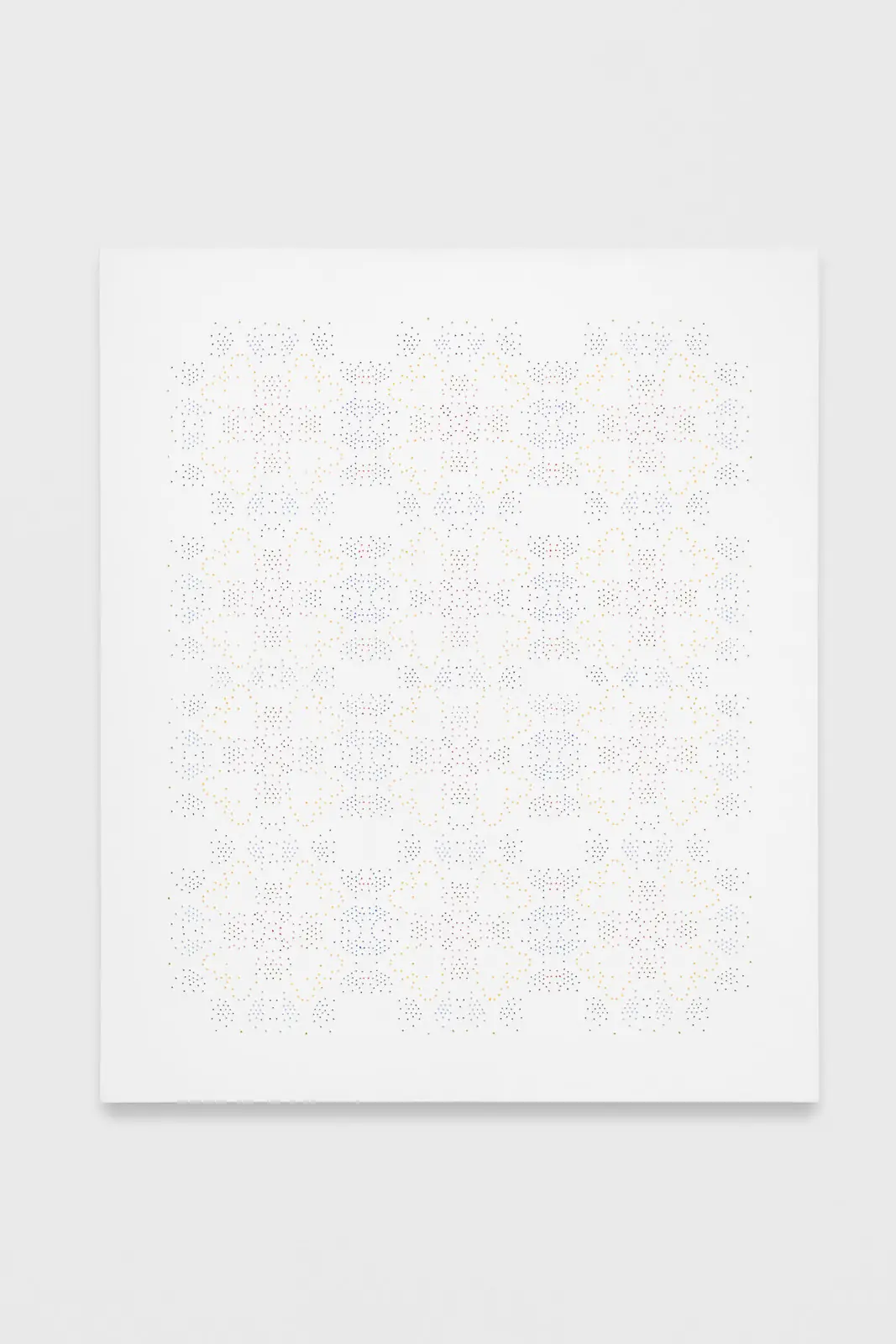
The exhibition takes shape as an ephemeral architecture that welcomes within it different actors in a discourse of spatial and narrative references. In the curve of the external window, watching over the rest of the space, Il branco, a carpet in dog hair obtained from grooming scraps. Crossing the threshold of the gallery, L’Insieme (Curtains), a series of pleated and partially perforated paper curtains, draws a path made of turns, interruptions, and openings: communicating corridors that complicate perception and challenge dynamics of visibility, in a play of thresholds that reveal and at the same time hide, lead and slow down. Between the folds of L’Insieme (Curtains), Pori (5941) and Pori (2980) make space, works on canvas studded with holes, whose precise number is indicated in the title, from which pictorial substance of different colors emerges. At the center of the space, Sottoinsieme (Square doily, Spiky doily, Star doily), a trilogy of jagged glass works rests on a wooden support. Along the unfolding of the folds on the walls, we are followed, reached, and accompanied by the light which, like an evidential indicator, gently signals a direction in space.
Compact yet floating, vital yet quiescent, material yet immaterial, À Jour is an ontologically multiple installation which, beyond the various formal declinations in which it manifests itself, expresses a peculiar mode of thinking the image and space. It is a posture similar, in many respects, to that of certain Eastern cultures, which mostly move away from figurative art and elevate geometry to a universal language. What in Western tradition is in fact relegated to “decoration” or “applied art” elsewhere assumes the function that here we attribute to art itself. Thus, in À Jour, surfaces are conceived to interact with light and to open to the third dimension, becoming the predisposed vehicle of a language not interested in representing the world through mimesis, but rather in bearing witness, through the luminous rays that spread, of the cosmic laws that regulate its existence.
In the complex field of forces that is generated, L’Insieme (Curtains) introduces a further reversal of paradigm. The perforated surfaces, acting as thresholds between inside and outside, let the light pass but not the gaze. Thus, the Western perspectival scheme is inverted, according to which the privileged point of view on the world is found in the human eye — which observes it as from a window wide open onto reality. Here the opposite happens: light penetrates from the outside and generates the experience inside, dissolving the centrality of vision and renegotiating the role of the subject as the main actor of the scene. It is a reversal ³ that breaks the univocity of the gaze and opens to a multiplicity of luminous trajectories, autonomous and divergent. In this scenario, perception becomes an exercise of attention rooted in the body, a cognitive and meditative act at the same time.
À Jour thus reveals itself as a true vibrating device ⁴, emblem of geometry and at the same time choreography of light, capable of acting and being acted upon by the bodies that cross it. A space that invites one to ask not so much “What is a body?”, but rather “What can a body do?” ⁵. What energies cross it? What possibilities does it contain? As Deleuze writes, taking up Spinoza: “No one knows what a body can do…” and I believe it is in this opening toward the unknown, that is, toward what reveals itself only in experience and in relation, that Pavoni’s work finds its generative strength.
2 Annika Pettini, poetic text on the work of Simona Pavoni.
3 Pavel Florensky, Reverse Perspective, edited by Adriano Dell’Asta, Piccola Biblioteca Adelphi 749, Adelphi, Milan 2020, p. 26.
4 On the term “vibrant” see Jane Bennett, Vibrant Matter. A Political Ecology of Things, Italian trans. by F. Zappino, Rome, Timeo Edizioni, 2021.
5 Gilles Deleuze, What Can a Body Do? Lessons on Spinoza, edited by F. Zappino, Verona, Ombre Corte, 2007.
Simona Pavoni’s practice is rooted in a material and process-based approach that allows the language of the material in its pure state to emerge, foregrounding the inherent agency of matter. The intrinsic properties of the material guide its manipulation and assert their presence within the work itself. In this sense, the work does not seek to represent but rather to reveal the very nature of the materials from which it is formed.
The title of the exhibition, À Jour, is a French term that refers to an embroidery technique based on the removal of individual threads from a fabric, allowing light to permeate. This bespoke (tailor-made) dimension is reflected in the installation, and the motif of the hole recurs in the works on view, such as the paper curtains L’Insieme (Curtains) (2025), the paintings Pori (2025), and the glass sculptures Sottoinsieme (Square doily, Spiky doily, Star doily) (2025). In the latter, matter – perforated and fragmented into tiny shards of tempered glass – reconstitutes itself into radial surfaces, producing a tension between contingency and control, between accidental fractures and deliberately pondered recompositions, held within containing geometries.
Pavoni’s practice unfolds from the very substance of her materials, often engaging elements deemed “expired” or post-functional. In À Jour, pattern-making paper, dog hair, and fragments of tempered glass – materials conventionally destined for disappearance – are collected, meticulously processed, and transformed into visual and spatial devices. Beyond the moment of creation, both preceding and following the material realization of her works, Pavoni employs a chain of processes, tools, and systems conceived specifically in response to the nature of the materials: from studio-fabricated tools – awls made from needles and screws, hand-rounded and calibrated to the millimeter to produce different holes – to carefully produced bespoke cardboard cases in which the works are transported beyond the exhibition threshold, modest and precious objects at once.
The works are the outcome of a secretive and ingenious process, where her immersive and spiritual approach converges with methodological rigor and programmatic discipline. Within the studio, patterns of points emerge, ordered according to a personal grammar: grids and modules unfold into quadrants, duplicate along Cartesian axes, mirror, shift, and rotate, generating geometric diagrams that function as cognitive matrices and visual instruments. Central to this sartorial ethos is embroidery not understood in its feminine or decorative connotation, but as a method: a minimal, repeated gesture that measures and renders time visible. From a central point, a propagation unfolds, expanding across surfaces and projecting through time until it becomes a woven structure. Here, subtraction becomes a constructive principle: it does not impoverish but enriches, transforming into a subtle presence, a minute yet precious ornament. For Pavoni, the hole is a generative nucleus, an emptiness that engenders form.
Repetition, born of this ritualistic and sartorial process, becomes both visual and temporal diagram: a meditative perforation governed by rigorous systems, in which each hole, on paper, canvas, or glass, corresponds to a discrete temporal unit calibrated to the rhythm of the human body. In the more than 30,000 perforations of À Jour, technique transcends itself to become a manifestation of duration: time is inscribed into space, segmenting and structuring perception. Deliberate pauses and material intervals give body to rhythm, rendering it tangible. Within this measured articulation resonates an echo of Lucio Fontana’s Spatialism, where in Concetti spaziali. Attese the incision introduces the fourth dimension – time – into the work. The multiple cuts embody the interval between gestures, making repetition visible as temporal measure. Similarly, in Pavoni’s perforations, the sequence becomes rhythm, pause, expectation. Her practice also resonates with the aesthetics of temporal recording in On Kawara: if in his Today series painting fixes the irreversibility of time into daily dates, while Pavoni’s perforation embodies duration itself, the smallest possible unit that measures and makes perceptible the passage of time.
A fundamental dimension of Pavoni’s practice is secrecy. The term, from the Latin secretum, derived from secernere “to separate, to set apart”, articulates the condition of what is withdrawn from immediate perception. Secrecy does not denote mere concealment but constitutes a generative principle: it separates to preserve, withholds to make precious, delays to intensify experience. Thus, her processes remain veiled: the backs of canvases never revealed, the perforated curtains disclose only partial glimpses, the light suggesting intimates’ presence without confirming it. As in a living organism, what is vital remains internal, unseen - and precisely by being withheld becomes essential. In À Jour, this logic shapes the exhibition space: curtains, recomposed glass, and paintings enact a dialectic between the visible and the invisible, apparition and withdrawal. The viewer is compelled to pause, slow down, and contemplate: the work unfolds not through immediate revelation, but within the sustained tension between what resists access and what comes to light.
×