Giacomo Mercuriali & Federico Tansella: States of Stagnation
Whether in economics, biology, or psychology, the term "stagnation" is generally used to describe a state of inactivity or lethargy, unequivocally disclosing negative connotations, often approached in reparatory or corrective terms. There is no time for siestas in hyper-productive societies: dormant slowness is left for idyllic pastoral sceneries, and psychological inertia is reserved for melancholic subjects or angsty teens, highly aestheticized and easily dismissed as unserious. The same fact that a stagnant body of water – far from lifeless, with its ideal conditions for microorganisms, bacteria, algae, and insects to thrive – is associated with decay, or at least neglect, leaves one to wonder what kind of vitality lies beyond apparent stillness that is, in fact, full of transformation beneath the surface. I write all this because, despite appearances, there is a vibrant feeling in the works gathered in the show at Mare Karina, be this Giacomo Mercuriali’s Giverny, Babylon series of prints – often involving romantic ponds among their settings – or Federico Tansella’s foggy, wilted, and sleepy works.
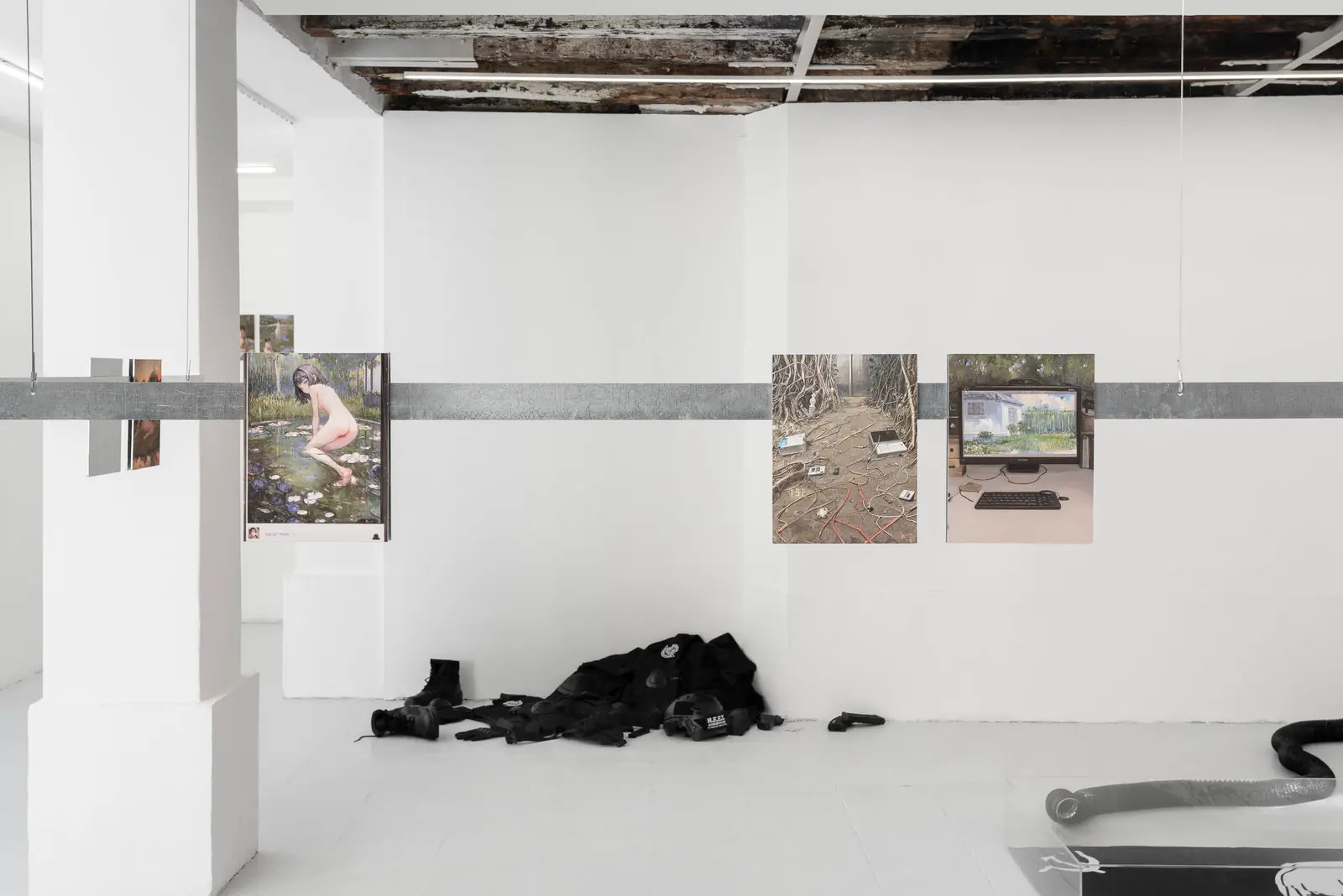
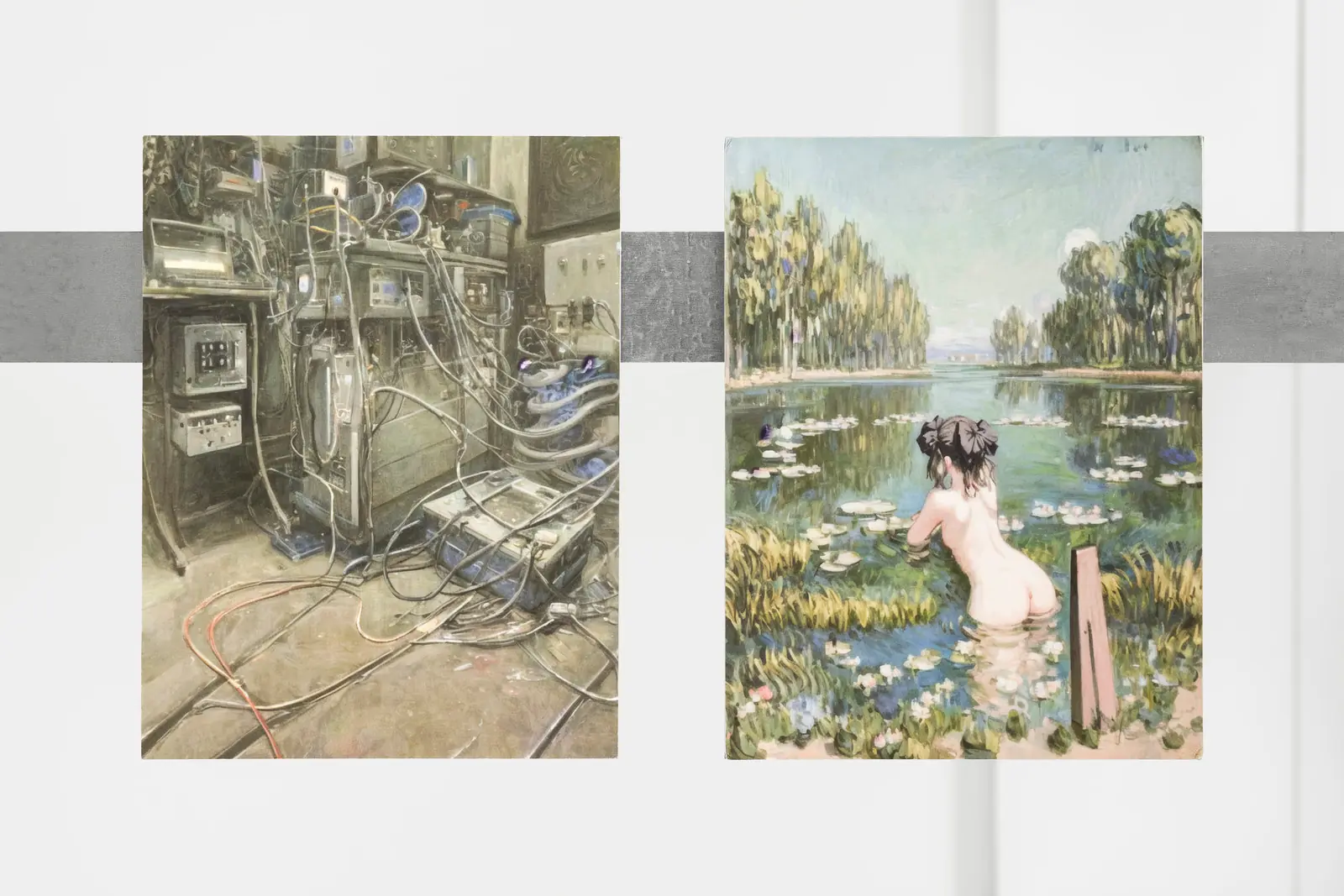
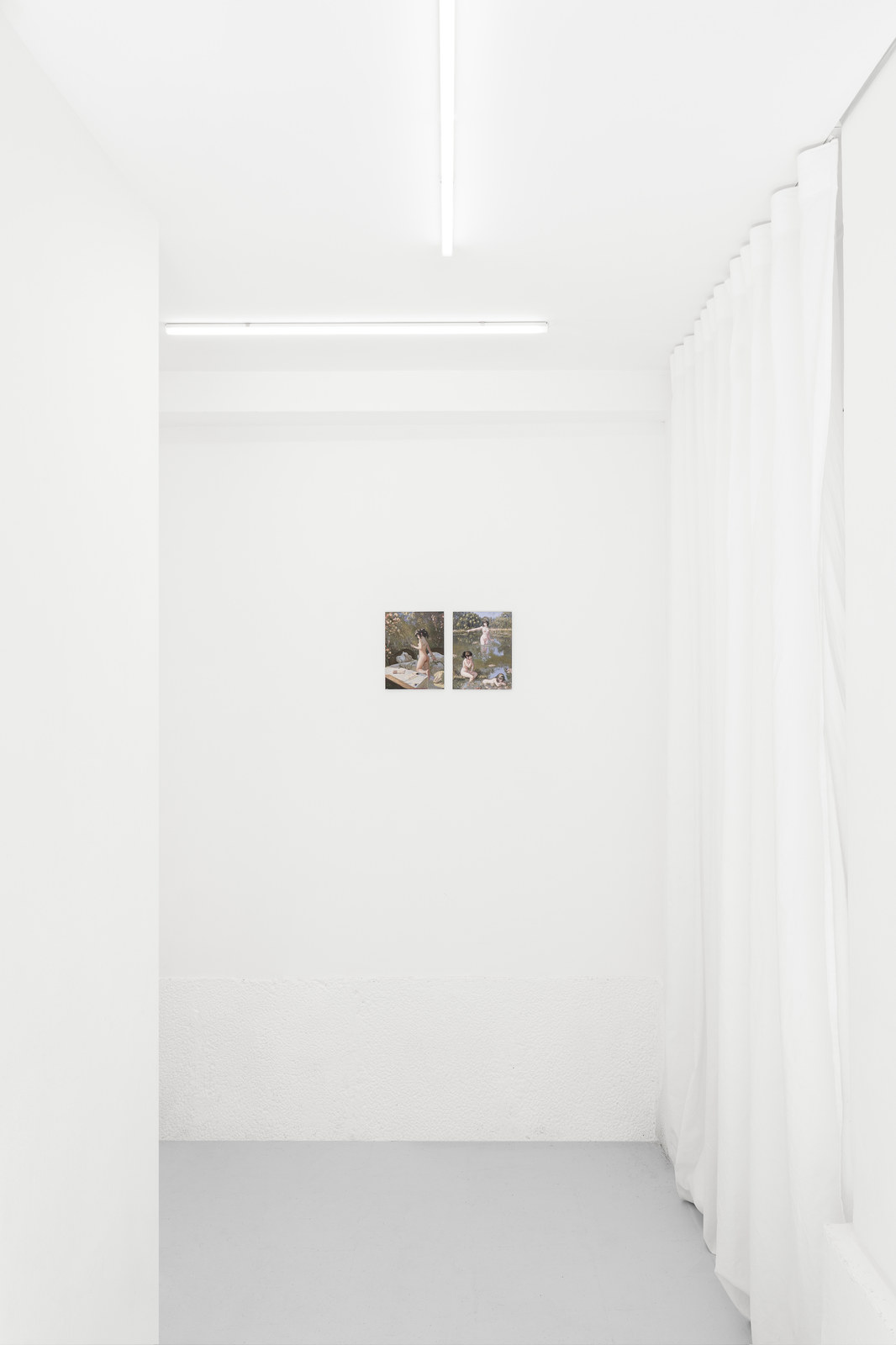
In Mercuriali’s painterly landscapes, the lushness of Impressionist tableau, with flourishing arcades and soft rays of light hitting water surfaces, becomes the background for rather contemporary twinkly nymphs. These naked figures – glossy and seductive, at times grotesque or strangely devoid – bridge the image composition into a whole different realm, typical of a digitally native taste for soft-core manga. With their uncanny resemblance to hand-painted textures, the images of the Giverny, Babylon series are the result of a trained generative text-to-image AI model, perfectly delivering misty brushstrokes and diffused light effects, as the act of painting is mimicked and corrupted. Here and there, one limb too many, computer tabs emerging among romantic rose gardens, or other glitches, give away the true nature of these works, exposing the mechanics of their creation. It’s cables and computer chargers the roots of the stagnant water lilies, and server-walls the trimmed hedges of these summer gardens. Other than being painterly but not paintings, the images defy hi-fi digital expectations too, as Mercuriali deliberately downgrades image resolution in favour of bulimic creation. After all, it’s the same stylistic choice that declares an ambition for big numbers as impressionism is universally accepted and pornographic manga-inspired imagery is usually a hit online. Hyper-production and pornography enter Mercuriali’s practice on a methodological level, manipulated into his own set of images. The resulting subjects exist in a hyper-mediated space of fantasy and frictionless satisfaction, collapsing the distance between viewer and image and offering an immediacy and appetibility that translates into a pleasing and erotic outcome. If porn is an evasion into a world of pre-packaged pleasure, Mercuriali’s work stages a similar act of illusionism: a deep-fake seducing the viewer while hacking the dominant systems of desire and their available tools. There is an enduring lightness among the swampiness of all those grey cable jungles, reflected in the display choices too, which show the structure behind these images while keeping their pep.
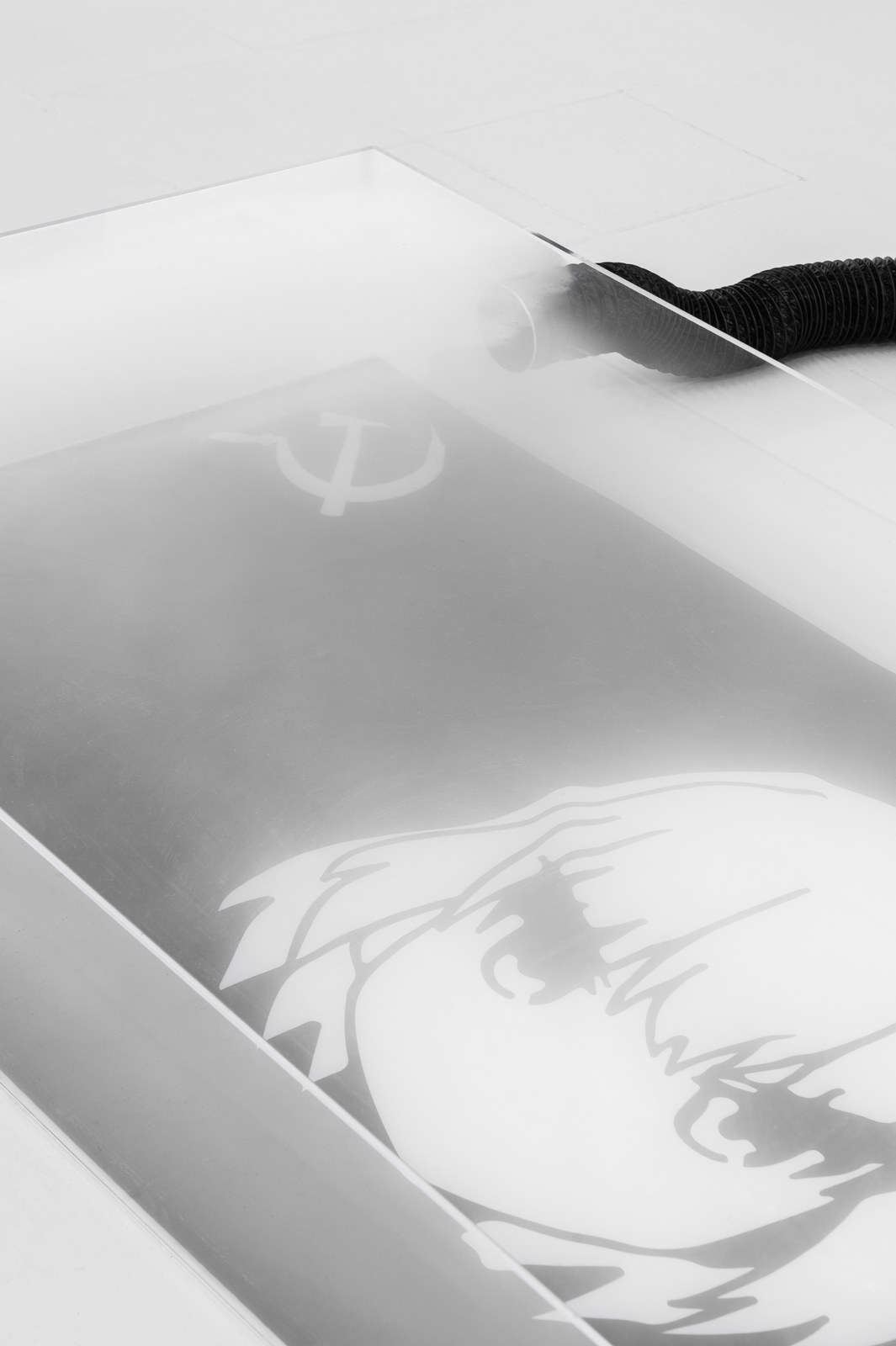
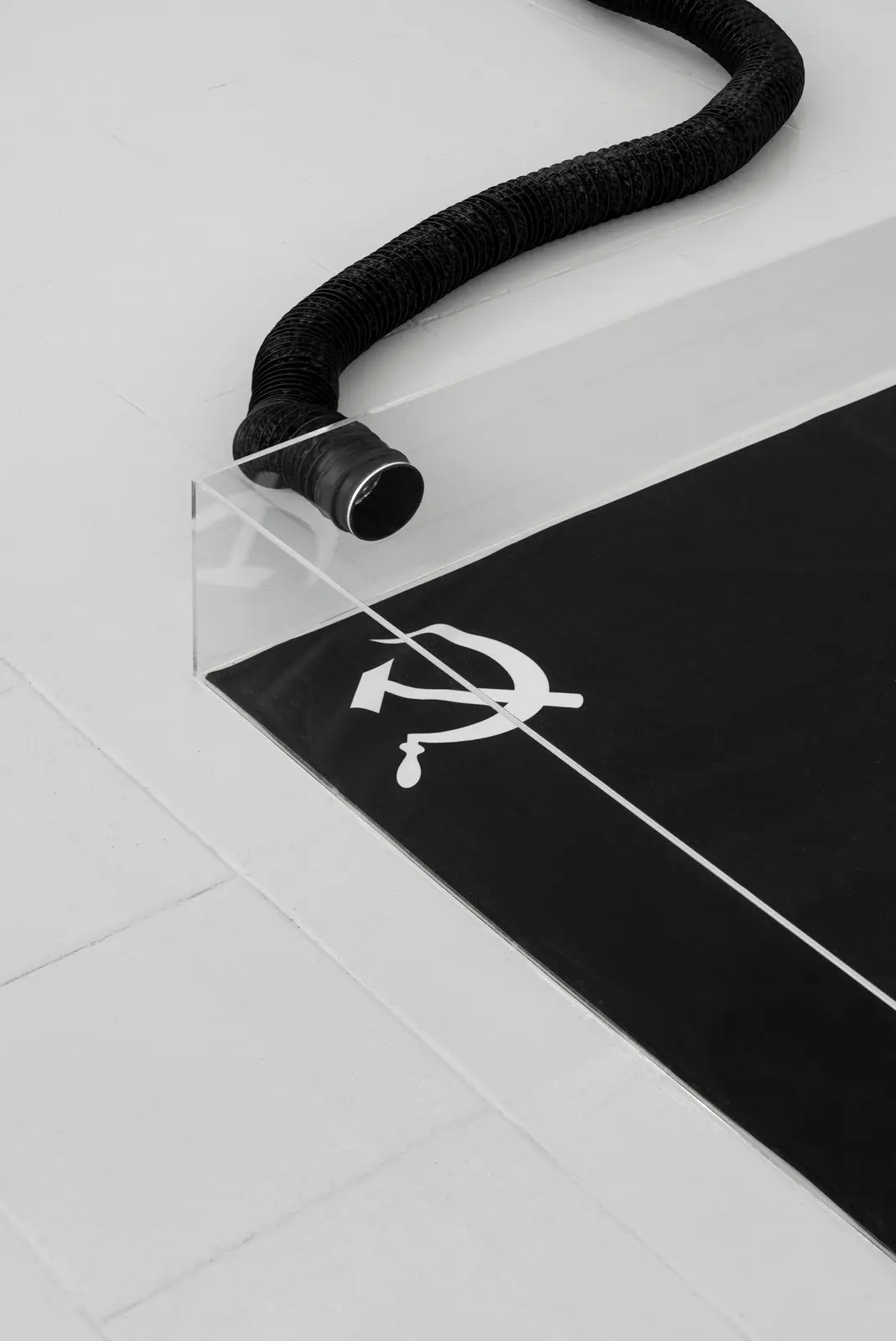
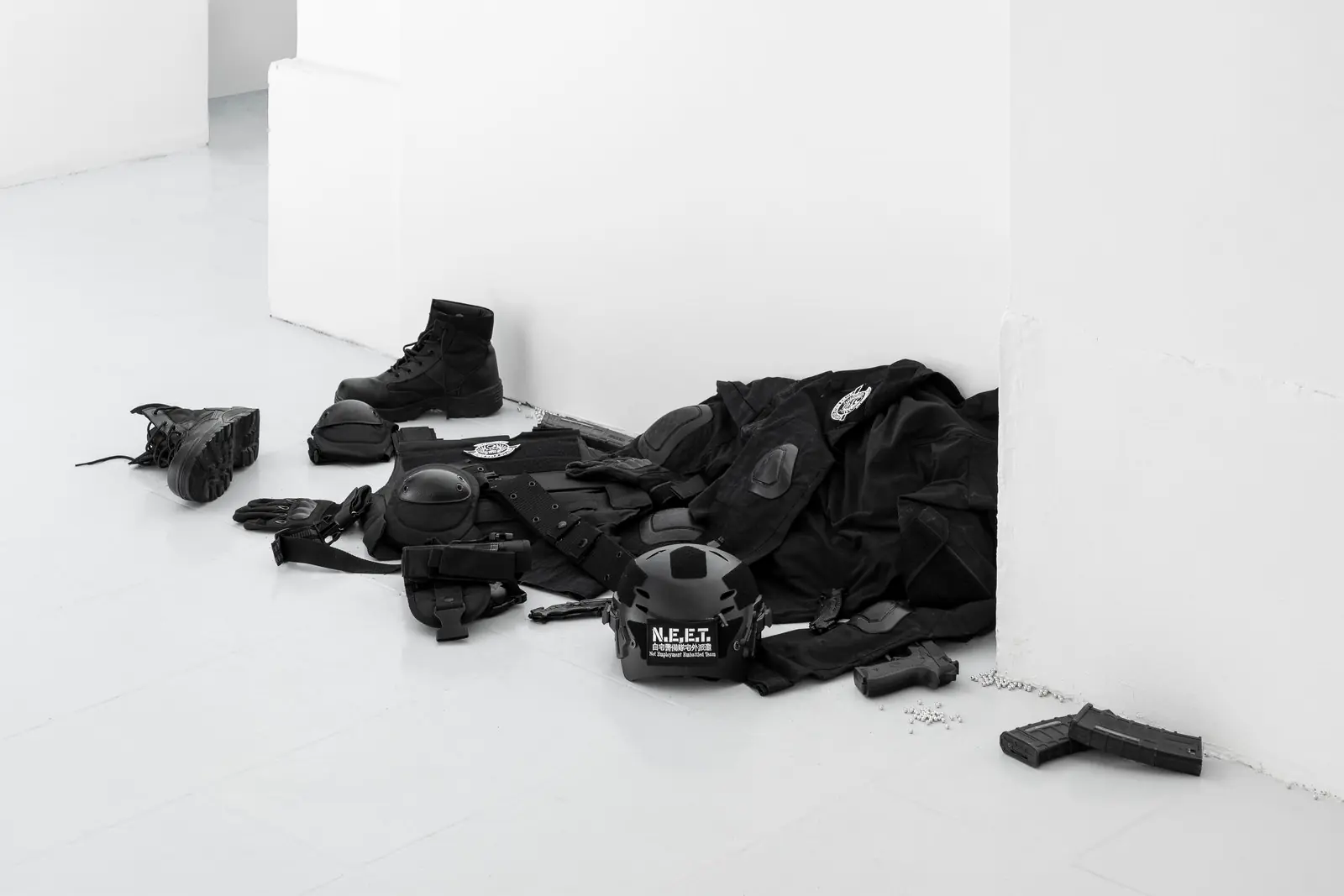
In the case of Federico Tansella, the relation to these same “systems” appears from a less opulent angle, characterised instead by subtraction and refusal. His research revolves around online communities of withdrawal and subcultures defined by their disengagement from society, in particular the NEETs – typically youth “Not in Education, Employment, or Training” – and hikikomori, also known as “modern-day hermits”. One of the pieces in the show is significantly titled For Those Who Lay Down and proposes a flag for a hypothetical socialist republic of the two communities. Like the members it represents, the flag is isolated and barely visible; encased horizontally on the floor, with a smoke machine incessantly filling its enclosures with a rather cold scent of sharp and metallic notes. Not far, an analogously spectral set of clothes lies wilted on the floor. It’s a NEET’s cosplay costume consisting of a full-fledged military uniform adorned with patches and stickers. Tired and disillusioned, this is the track of an absent body and it exists marrowless, dissolving into inert resistance while mocking the symbols of state power and control.
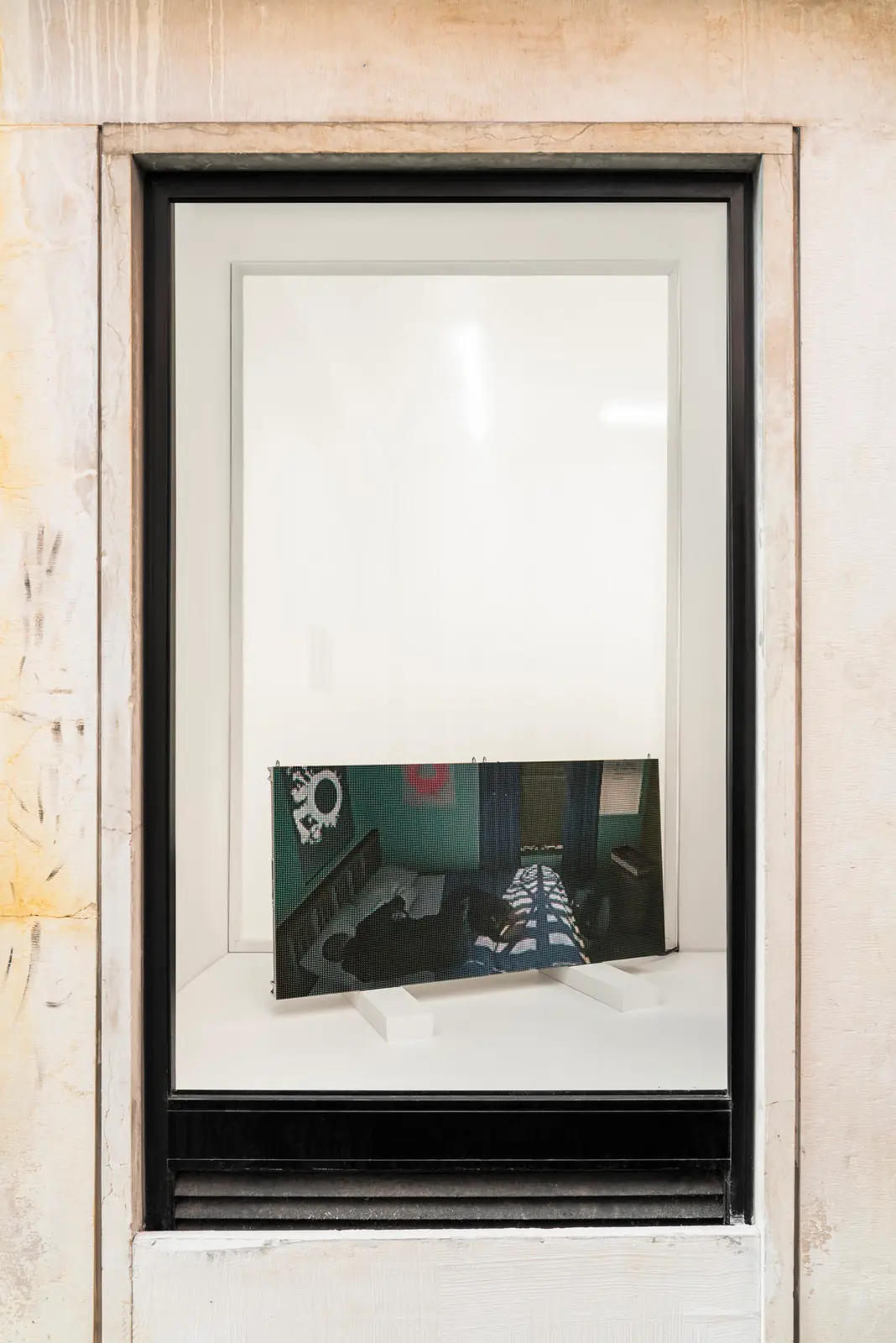
In the gallery vitrine, a real-time video follows an avatar of the computer game Grand Theft Auto V, who chooses to lie in bed. As the light conditions gradually change from early morning rays up to a deep black night, the video shows nothing but the barely moving avatar in his bedroom, exposed in his transgressing the pre-set of rules of a game knowingly designed for action, accumulation, and social climbing. Inspired by the 2000s sleeping streams trend on live streaming platforms, the work is viewable online 24/7 live on a dedicated website, and it delivers the notion that agency is a hontological choice, and refusal might also mean slowing down.
Overall, the bodies in the show – enclosed like precious gems in rigid steel and plexiglass boxes, or de/animated in exaggerated fashion – contextualise a decorporealization resulting from online and digital culture, letting hyper-visibility and massification meet with withdrawal and disappearance. This is not just presented in dystopic terms, though as Mercuriali and Tansella have a fascination for methodologies posited at the opposite end of a spectrum of non/actions, which come closer than one would guess. Both artists toy with given conditions as an exercise of evasion, hacking and belonging. Degradation, or actions perceived as such, are employed as an eroding tool, and an encrypted force of refusal, nodding to the technological effect on redefining narratives, while understanding its logic and proposing alternatives. That’s how melancholic tones get transformed in winks, perfectly delivering attitudes and methodologies quite dear to a pop legacy. It’s enough to recall Andy Wharol’s serigraphies and his anti-films, the first of which showed Warhol's lover at the time, sleeping for five hours and twenty-one minutes.
Loyal to their mission, Mercuriali and Tansella ended-up hacking each other too! A mysterious flag appears in one of the prints in the shows, lonely and rumpled, enclosed in a steel fortress on the wall, while hidden humorous references are to be found in the real-time video, following the easter-egg gaming tradition. It is not by chance either that this show happens in Venice. As the 1982 song by Bahuaus, also referenced in one of the works, says “All We Ever Wanted Was Everything”: a truth, a round breast, a familiar lagunar stillness hiding the lymph of living.
States of Stagnation is part of a series started in 2019 by Caterina Avataneo, based on duo-collaborations between artists with divergent practices, employing very different concerns, mediums or aesthetic languages. The intent is to contribute to shaping the final show through conversation and togetherness, letting the project unfold differently and organically every time. Generally sharing one single room, the space becomes an active agent in which the act of interweaving divergent practices generates new work or new links between existing artworks, exploring the collaborative nature of producing meaning out of differences. The first collaboration happened in 2019 with Anna Barham & Chiara Camoni at Arcade (London); followed in 2020 with Diego Delas & Rolf Nowotny at HAUS (Wien); and with Giuliana Rosso & Rory Pilgrim at Pina (Wien); then in 2022 with Jeremiah Day and Anastasia Sosunova at SixtyEight Art Institute (Copenaghen).
×Federico Tansella is an artist and sound designer currently based in Venice, where he studies Multimedia Art at the Academy of Fine Arts. His practice navigates contemporary sociological phenomena, addressing emergent pathologies, new forms of violence, and speculative futures through an expanded field of sound, video, installation, and performance.
Under the alias Meynsense, he pursues his experimental music venture, performing live in multiple venues across Italy and developing a distinct research that delves into the intersections of sound, technology, and perception. Alongside this, he works internationally on commissions and collaborations as a sound designer and composer, contributing to a wide range of creative endeavours. His original sound compositions have been featured in projects based in Venice, Milan, Paris, and Tokyo, with collaborations including Missoni, Marine Serre, SANDRO, and MM6.
His ability to distill the logic of contemporary digital trends into sonic and visual environments positions his work at the threshold of online chaos and its most fragile, often violent, human consequences.
Giacomo Mercuriali is an artist and theorist whose work bridges philosophy, anthropology, and new media. He holds an MA in Art History and Criticism from the University of Milan and pursued a PhD in Philosophy. His academic trajectory includes research at the École des Hautes Études en Sciences Sociales in Paris, where he investigated visual anthropology and the semiotics of power.
Parallel to his scholarly work, Mercuriali has cultivated an experimental artistic language through social media. In 2020, he launched the Instagram account @young_agamben as an anonymous extension of his philosophical and political inquiries—an online space where memes, AI-generated visuals, and reels operate as tools for critical discourse. Over time, the account has evolved into a reference point for an international network of artists, philosophers, architects, designers, photographers, musicians, and curators.
Mercuriali's ability to harness the aesthetics of social media as a medium in itself has redefined the contours of theory and practice, positioning contemporary visual culture as a site of intervention and speculation.
For this exhibition, Mare Karina is excited to invite Turin-based independent curator Caterina Avataneo.
Before moving back to Italy, Avataneo was working and studying in London where she completed an MA in Curating from London Metropolitan University and Whitechapel Gallery (2017). Between 2018-2021 she worked as Assistant Curator on assigned projects at Serpentine Gallery (London), and in 2019 she was Assistant Curator of Sun & Sea (Marina), the Lithuanian Pavilion for the 58th Venice Biennale - winner of the Golden Lion. She has been the curator of the VII Edition of the Club GAMeC Prize (Bergamo) in 2022, and curatorial consultant for the New Entries section for emerging galleries at Artissima (Turin) in 2022 and 2023.
Currently, Avataneo runs a series of duo-collaborative shows which have been exhibited internationally since 2019, and for five years she has been curating the residency fellowship programme at Cripta747 (Turin). Since 2022 she also co-curates the Digital Fellowship programme for Pompeii Commitment. Archaeological Matters – the first long-term, contemporary art programme established by the Archaeological Park of Pompeii. She is working with Hans Ulrich Obrist and Josh Willdigg to develop new commissions with 11 artists and 11 footballers for an exhibition opening in summer 2025 at Factory International (Manchester) as part of Manchester International Festival. She writes a series of "in conversation with" for PW-Magazine and she is editorial coordinator for CURA., where she also writes.